Puzzle
is a recessive gene in the ball python (Python regius), known primarily for its distinctive, highly modified, sharp yet fairly orderly pattern on the sides of the body. The mutation was confirmed as a distinct gene in 2011 by Exotics by Nature Co.The history of Puzzle began in 2003, when Sean Bradley purchased a male Super Pastel from Greg Graziani. In 2008, the first unusually-looking hatchlings were hatched from the offspring of these animals, which turned out to be Puzzle.
Cross-breeding carried out in 2009 showed that the gene originated from the female, rather than from Graziani’s male. In 2011, Sean produced the first single-gene Puzzle, confirming that it is an independent recessive gene, unrelated to Pastel.
Appearance
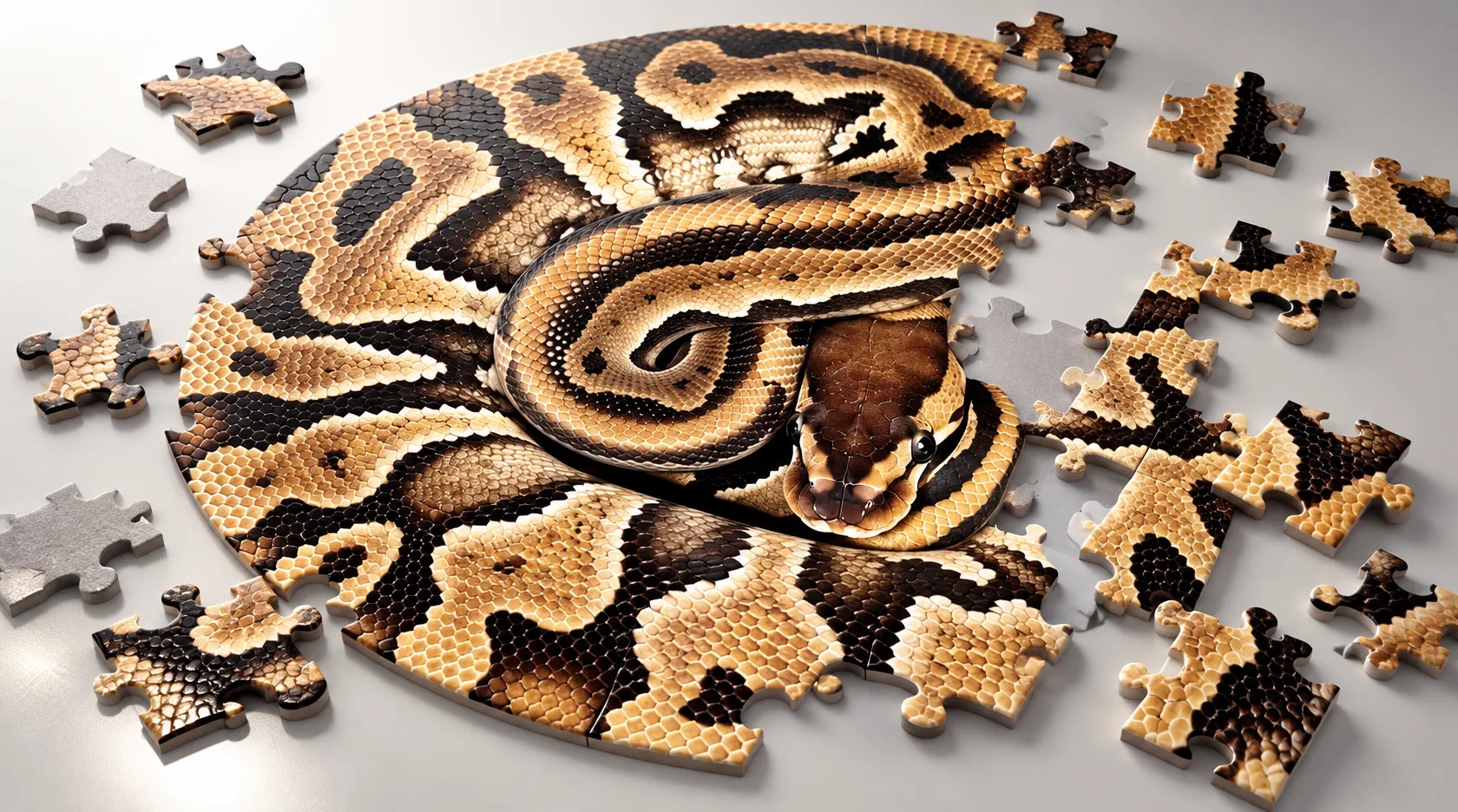
Puzzles typically have a distinctly fragmented, irregular side pattern consisting of large ‘alien heads’ with fairly regular edges, which may resemble interlocking jigsaw puzzle pieces. The pattern is often high-contrast and gives the animal a very distinctive appearance. The head remains relatively close to the normal form, though it may be slightly darker.
Genetics
Puzzle is a recessive gene. This means that, to exhibit the Puzzle phenotype, a young animal must inherit a copy of the gene from both parents. Individuals with only one copy of the gene are heterozygous (het Puzzle) and usually resemble the nominal form.
Puzzle in combinations
Puzzle looks particularly interesting when combined with other morphs, further altering their pattern and appearance. Puzzle is primarily a pattern gene — its greatest strength lies precisely in the way it modifies the python’s flanks and how it behaves when combined with other genes. The popularity of this gene is constantly growing, and breeders are continually discovering its ever-increasing potential.
See examples of individuals carrying the Puzzle gene
https://reptimarket.pl/zwierze/6d3f6408-fa78-4b2f-9710-9f67e0424044https://reptimarket.pl/zwierze/787f4344-6b6e-4446-9c38-9ed937724b4b