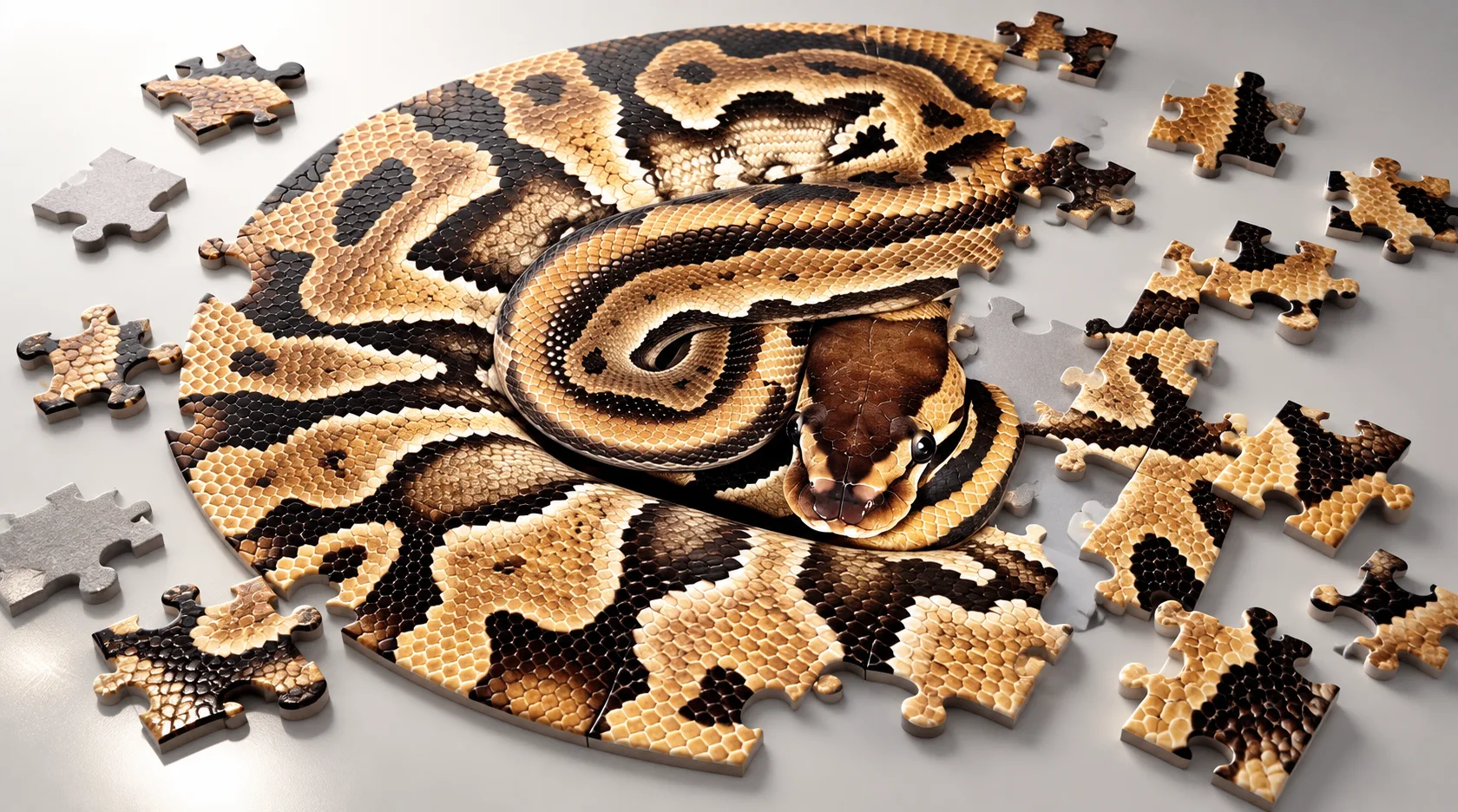
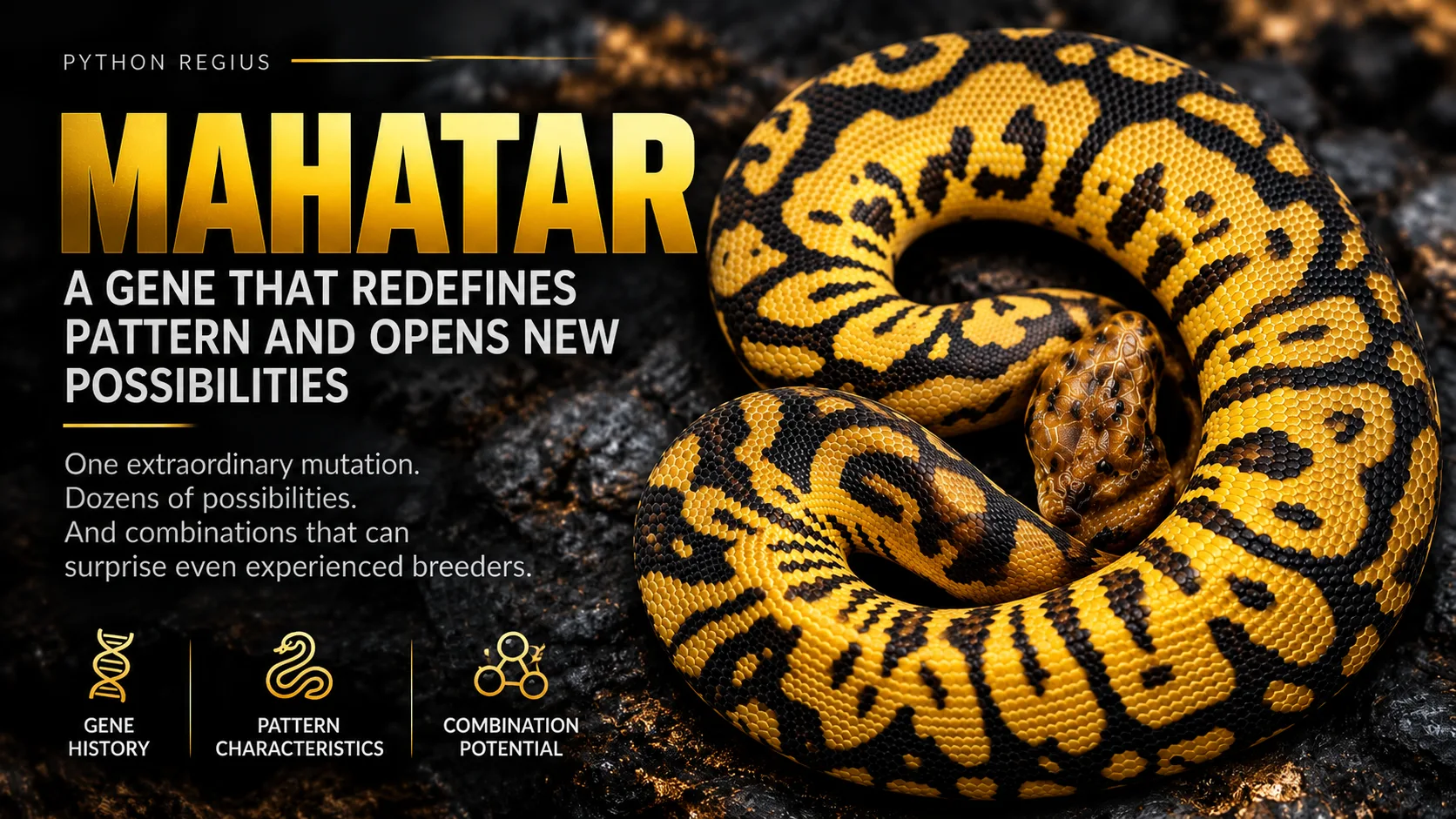
MAHATAR — a gene that changes the pattern and opens up new possibilities 🐍
From an African import to extraordinary combinations. Mahatar is a story of breeding patience, a distinctive pattern and a gene whose potential is still being discovered.
Some genes change colour. Others modify individual elements of the pattern. Mahatar goes much further — it alters the structure of the classic royal python pattern, giving it a raw, irregular and almost mosaic-like appearance.
Today, breeders’ attention is drawn not only to the Mahatar itself, but also to its ‘Super’ form and unique combinations, such as the Mahatar Black Head Clown. And this may only be the beginning.
From an African import to a new gene
The history of Mahatar dates back to 2007, when German breeder Gerlinde Hiendlmeyer acquired a female from an African import. The animal stood out for its unusual pattern, but it was only in the following years of the breeding facility that it became clear whether this trait was hereditary.
In subsequent generations, young birds with a similar appearance began to appear. Further matings were therefore undertaken to investigate the mode of inheritance and the effect of this trait on the offspring.
Thus began the story of Mahatar — a line whose distinctive phenotype attracts the attention of breeders interested in significant pattern variation.
What makes Mahatar stand out?
Mahatar is classified as an incomplete dominant gene. Its main effect is a change in the structure of the classic royal python pattern.
Traits associated with this gene include:
- a dark head and a distinct transition in pigmentation around the neck,
- a heavily modified, irregular ‘Granite’-type pattern,
- a darker body tone,
- the breakdown of the classic pattern elements into smaller fragments,
- pattern variations also visible further down the body.
The final appearance of a particular individual also depends on the other genes present in its genotype.
Super Mahatar — the next stage in the breed’s history
An important stage in the development of this line was the attainment of a homozygous form, known as Super Mahatar.
Under the classical model of incomplete dominance, mating two Mahatar individuals theoretically yields the following proportions:
- 25 per cent — individuals without the Mahatar gene,
- 50 per cent — Mahatar,
- 25% — Super Mahatar.
These are statistical proportions, and the actual results of individual broods may vary. Obtaining the Super form allows us to better understand how the gene functions and to examine how the phenotype changes when two copies of the gene are present.
Mahatar Black Head Clown — a combination that catches the eye
A specimen presented by the Polish breeder Marcin Binkowski as the Mahatar Black Head Clown has attracted particular interest.
This combination brings together three genes with differing effects on appearance:
- Mahatar — significantly modifies the pattern,
- Black Head — influences the dark pigmentation of the head and the character of the pattern,
- Clown — alters the layout of the classic pattern, giving it a distinctive appearance.
“The first and only one in the world.”
This is how the author of the listing described their specimen, emphasising its uniqueness.
The claim that this is the first specimen of its kind in the world should be treated as information provided by the breeder, rather than as an independently verified record of all existing combinations.
Marcin Binkowski also announced that he is eagerly awaiting the results of crossing this combination with the Monarch and Desert Ghost genes.
Such projects may yield interesting results, combining a strong pattern modification with additional changes in appearance. Their final outcome will only be assessable once the offspring have been produced and observed.
Mahatar and other Granite-type genes
Mahatar shows similarities to other genes described by breeders as ‘Granite-type’. However, the mere similarity of the phenotype does not mean that all these lines are the result of the same mutation.
The relationships between similar genes require appropriate breeding tests, whilst unequivocally determining their molecular basis requires DNA analysis.
There is currently no publicly confirmed information regarding the specific DNA variant responsible for Mahatar. It is therefore important to distinguish between confirmation of inheritance in the breeding facility and full molecular identification.
Mahatar — a story that continues to unfold
From an extraordinary female imported from Africa to Super Mahatar and multi-gene combinations — the history of this line shows just how much time and effort is required to develop new genetic projects.
Mahatar Black Head Clown is an example of how breeders combine different genes to achieve increasingly distinctive phenotypes.
The announced crossbreeds with Monarch and Desert Ghost could become the next exciting chapter in this story.
The royal python breeding facility is not just about what we see today. Equally important is what future generations may reveal tomorrow.
ReptiMarket 🐍🧬
Photo courtesy of Marcin.